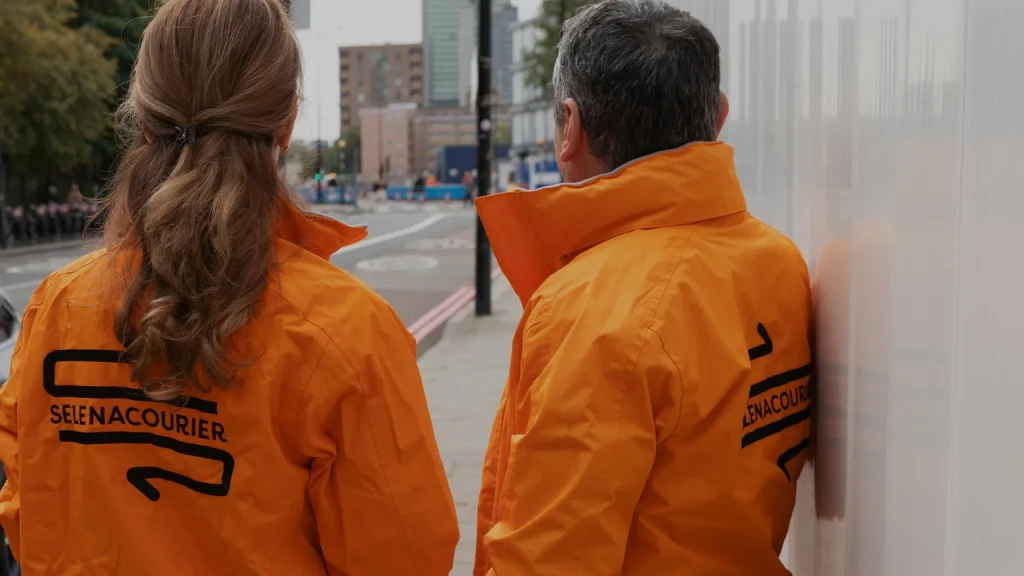
As a business owner, you probably do not want to spend your afternoon chasing a courier.
You want to know when your goods will be collected, whether they will arrive on time and that the person delivering them understands what they represent.
For many London businesses, the technology available to book deliveries has never been more convenient. Yet our conversations with small businesses, growing companies and established brands keep returning to the same challenge.
Booking a courier is easy. Managing the delivery experience is considerably more complicated.
At Selena Courier Service, now in our twentieth year in London, we believe this is where the difference between platform-led and human-led logistics matters.
Key Takeaways
- Courier platforms are convenient and can suit straightforward, low-risk deliveries.
- When delivery becomes part of your operation or your customer’s experience, you also need someone responsible for the exceptions.
- A human-led courier service uses experienced coordinators to plan, brief, communicate and resolve problems, supported by technology.
- Predictable collection times, a courier who understands the goods and someone to call can be worth more than the lowest quoted price.
- Accountability is tested when something goes wrong: owning the problem, telling the client early and improving the process.
The rise of platform-led delivery
Digital courier platforms have made deliveries more accessible. They can provide quick quotations, flexible booking options and access to large networks of independent couriers.
For straightforward, low-risk deliveries, this model can be entirely appropriate.
However, when delivery becomes part of your business operations or your customer’s experience, your requirements may extend beyond what an automated booking process can provide on its own.
Your business may need:
- A reliable collection window.
- A courier familiar with your products.
- An understanding of your customer’s expectations.
- Flexibility when production runs late.
- Someone available to call when circumstances change.
- Proactive communication before a small problem becomes a client complaint.
The question is not whether technology is useful. It is who remains responsible for the delivery when human judgement is needed.
What is a human-led courier service?
A human-led courier service uses experienced coordinators to manage delivery planning, courier allocation, communication and exceptions, supported by appropriate technology. The booking may be digital, but a named person stays responsible for the delivery from collection to handover.
Case 1: A London florist and the uncertainty of collection
In a recent conversation with an established London florist, we discussed their requirements for around 25 flower arrangements each week.
Their flowers are prepared on the day of delivery. Orders arrive throughout the day, and arrangements are typically ready one to two hours after being placed.
Their challenge was not simply finding a delivery provider. It was finding a reliable courier, and knowing how long it would take for that courier to arrive.
For a florist, unpredictable collection times can disrupt the entire working day. Staff have to coordinate production, prepare fragile arrangements, manage customer expectations and respond to new orders. When collection timing is uncertain, the florist is left managing another operational variable.
And when flowers arrive at a customer’s home, they represent the florist’s craftsmanship, reputation and brand.
The approach we proposed focuses on predictable collection windows, appropriate vehicles, carefully planned delivery rounds and one coordinator who confirms when the courier will arrive.
Sometimes the most valuable part of a courier service is knowing exactly when someone is coming.
Case 2: When catering logistics become part of the event
Earlier this year, we explored a delivery partnership with a growing London catering business supporting corporate offices, conferences and technology events.
The requirement was considerably more complex than delivering food from one address to another. We discussed:
- Multiple restaurant collections.
- Breakfast, lunch and evening catering deadlines.
- Venue-specific access instructions.
- Appropriate vehicle capacity.
- Professional courier presentation.
- Last-minute changes during live events.
- Direct communication with event organisers.
We also looked at how delivery operations could connect with the client’s own systems while keeping human oversight.
The experience reinforced an important commercial distinction. A business can choose a lower-priced delivery model. But it should also consider who will manage the operational complexity behind each booking.
If catering arrives late at a conference, the consequences are not limited to the cost of the courier. They reach the organiser, the attendees, the catering business and its future client relationships.
Case 3: Why understanding a bakery matters
One of our regular bakery operations involves early-morning deliveries across London.
A bakery is a live production environment. Orders change, quantities fluctuate, products may not be ready at exactly the expected time, and delivery schedules can need immediate adjustment.
An experienced courier needs to understand this environment. When the delivery list does not match the goods available for collection, someone needs to establish what has changed.
Has an additional order been prepared? Is a box missing? Does another destination need to be included?
At Selena, our approach is to speak with the bakery and the courier, clarify the discrepancy and make an informed decision. Simply recording that a collection has taken place does not resolve the underlying problem. We describe the same discipline in when delivery instructions change.
This is the difference between transporting goods and supporting a business operation.
What couriers tell us about working with delivery apps
The courier’s perspective matters just as much.
In a recent conversation with one of our experienced couriers, we discussed the reality of working across several delivery platforms. Couriers may have two or three applications running throughout the day, weighing available jobs, locations, journey times and earnings.
As he put it:
“They will be juggling two or three apps with different courier companies.”
That is a very different working environment from a planned, relationship-led courier operation.
In a human-led model, couriers are briefed on the client’s requirements, understand why a deadline matters and can reach a coordinator when something unexpected happens.
We want our couriers to understand why a particular delivery matters. A box of pastries for a bakery, a bouquet for an anniversary and a confidential package for a healthcare provider may all need very different approaches.
Supporting our couriers is part of supporting our clients.
The importance of simply picking up the phone
Technology can tell us that a delivery is delayed. A conversation can help us find out why, and what we can do about it.
Imagine a courier arrives at a London office and discovers that the named recipient is unavailable. A delivery cannot always be resolved by selecting a status in an app. Someone may need to contact reception, speak to the recipient, confirm another authorised person or arrange a different handover.
The same applies when:
- A florist’s order is not ready.
- A restaurant has additional items.
- A venue changes its loading entrance.
- A concierge needs a specific handover.
- A pharmacy recipient needs more time to answer the door.
These are everyday situations in London logistics. A phone call, made at the right moment, can prevent an unsuccessful delivery and unnecessary disruption. It is the same principle behind proactive courier communication.
Human-led does not mean technology-free
At Selena, we use technology wherever it helps: digital booking, route planning, structured operational processes and delivery confirmations. We keep investing in automation that improves visibility and removes unnecessary administration.
But technology should support human decision-making. It should not remove responsibility.
- Platform-first: Automated job allocation. Human-led: Allocation based on suitability and availability.
- Platform-first: Standard booking information. Human-led: Understanding specific operational requirements.
- Platform-first: Digital delivery status. Human-led: Delivery status with proactive human intervention.
- Platform-first: Transaction-focused relationship. Human-led: Ongoing business relationship.
- Platform-first: Standardised delivery processes. Human-led: Agreed handling and handover procedures.
- Platform-first: Price optimisation. Human-led: Service, reliability and total operational value.
Individual providers vary, and some platforms offer strong human support. Businesses should evaluate the actual service behind the technology, not simply its label.
When something goes wrong, accountability matters
No professional courier company can honestly promise that unexpected situations will never occur. London traffic changes. Vehicles develop problems. Production schedules move. People make mistakes.
We have experienced these situations ourselves.
After a delay on one of our time-critical bakery deliveries, we recognised that the issue was not only the missed deadline. Our communication should have reached the client sooner.
We acknowledged the failure, contacted the client personally, credited the affected delivery and set stronger monitoring and escalation requirements for time-critical routes.
For us, accountability means owning the problem, learning from it and improving the service. It is also why we sometimes say no to a job we cannot do properly.
Is the cheapest courier the cheapest option for your business?
The quoted delivery price is only one part of the commercial equation. Businesses should also consider:
- Staff time spent chasing couriers.
- Replacement deliveries.
- Missed deadlines.
- Refunds and customer complaints.
- Damaged or mishandled products.
- Lost repeat business.
- The reputational cost of a poor customer experience.
A reliable courier partner should reduce this operational burden. We look at these costs in more detail in why businesses move away from generic couriers.
For businesses that have spent years building a reputation, delivery is not an isolated transaction. It is the final stage of their customer experience.
Choosing a courier partner that represents your brand
A florist, a luxury retailer, a bakery, a PR agency and a medical business work in very different industries. But they share something important: they care about what happens to their products after they leave the premises.
At Selena Courier Service, our role is to extend that care beyond their doors.
Founded in London in 2007, Selena was named Best Boutique Logistics Partner 2026 at the SME News Greater London Enterprise Awards. We offer same-day, urgent and regular delivery support for London businesses.
In our twentieth year, our commitment is the same: technology, experienced people, direct communication and personal accountability. Human-led. Technology-supported. Personally accountable.
We do not simply deliver your products. We help protect the experience you have created around them.
If your business is reviewing its delivery arrangements, struggling with unpredictable collections or looking for a reliable supporting courier partner in London, we would welcome a conversation. You can request a quote or call us on 020 3674 0409.
Sometimes understanding your requirements begins with something as simple as picking up the phone.